Our Vision
A planet with healthy, thriving ecosystems where women are recognized, resourced, and supported as guardians and stewards of nature.
Our Purpose
We invest directly in grassroots conservation initiatives—designed and led by women—that protect nature while supporting women’s rights and well-being.
Our Values
Be curious, listen, and learn.
Be humble, responsible, inclusive.
Be collaborative.
Build community.
No one should feel alone.
Our Strategy
-
Because women working on the frontlines of climate change and biodiversity loss continue to be massively underfunded and because the majority of funding goes primarily to agricultural development and food security, we aim to channel funding to women designing and leading grassroots projects that protect biodiversity, forests, rivers and oceans, while simultaneously uplifting women.
-
A unique strength of the Superbloom Fund is that we provide not only grants but also a community of support, care, connection, learning, and solidarity. We are investing in whole women—their leadership, wellbeing, organizations, communities, and dreams—and creating a global sisterhood of women who are protecting and restoring life on Earth together.
Superbloom will develop a Holistic Partner Support Program that responds to the priorities identified by women themselves.
-
From the Chipko movement in India to the Greenbelt movement in Kenya and the global #MeToo movement, it’s clear that women are at their most powerful when they work together. We are investing in our grantees financially, but we also support them by connecting them with other donors and opportunities to learn and share with each other. We do this in relationship with our partners, connecting them with each other to share lessons learned. We also do this by connecting our grantees to other donors, with opportunities, with other women working on similar projects, and with larger existing women’s networks. We believe that in connecting women, we can help to reinforce their missions.
-
How can projects led by women receive more support when we don’t know about them? As one of the key strategies of the Superbloom Fund, we are going to highlight successful projects in our reporting to donors, outreach material, partnerships, and media. We will draw on our storytelling skills to get the word out.
Superbloom’s strategy is built around four mutually reinforcing foundational pillars:
Together, these four approaches enable us to move resources where they are most needed, strengthen the women leading change, build powerful networks and collaborations, and ensure that their work is seen, valued, and supported.
Priorities
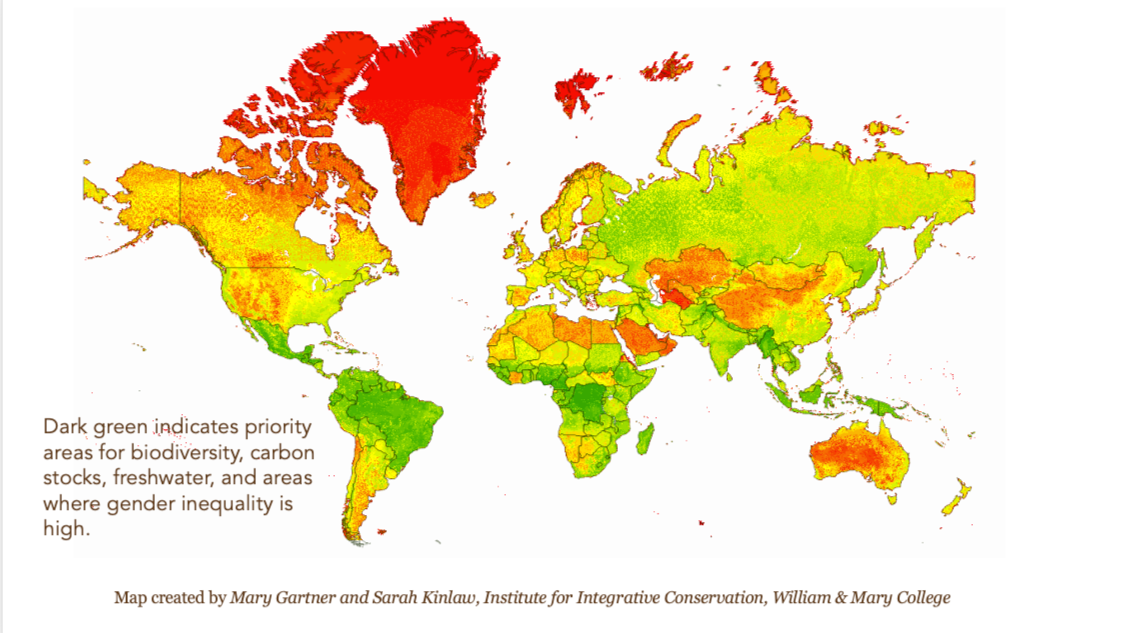
In 2026, Superbloom worked with the Institute for Integrative Conservation at William & Mary College to overlay conservation geographic priorities with investment profiles for women, to better understand where we should focus our efforts. The students created maps and data that mapped areas that underscore biodiversity, carbon forests, freshwater, and access to future areas of high potential for conservation investment. Onto this map, they overlaid a data layer of UNDP’s Human Development Report Gender Inequality Index (GII). This is because climate change and biodiversity loss are not impacting all areas of the planet equally, nor all people equally. Women are among those most impacted by climate change, and this is most true in areas of the world where gender inequality is highest. We therefore aim to prioritize funding to areas at the intersection of importance for biodiversity, carbon, and water, and where gender inequality is highest.
Funding is focused on the following key priorities:
-
Biodiversity is a term used to describe the diversity of life on Earth. Ecosystems are made up of species, each with its own niche and role within the functioning ecosystem. Fungi, bacteria, fish, and amphibians are all critical players in this web of life. Wildlife species—such as lions, elephants, orcas, and wolves—are not only important to protect in their own right, but also because they have vital roles in these broader ecosystems. They are often umbrella species with geographic ranges that overlap many regions of the world where biodiversity is at great risk. They are also often outstanding flagship species for conservation. They are charismatic and can help stimulate awareness, action, and funding.
Yet very little funding goes to women working to protect wildlife species, since most funding for women is directed toward sustainable agriculture. While agriculture is an important reason for biodiversity loss, it is not the only one. Women play a critical role in food production, but we are also scientists, rangers, researchers, and advocates, and we play critical roles in decreasing negative interactions between humans and wildlife. Because sustainable agriculture is already receiving funding, we aim to support biodiversity conservation where very few funds are directed at present. We fund projects that support the protection and recovery of species with a focus on healthy, thriving ecosystems.
One unique aspect of the Superbloom Fund is that we don't just fund women doing conservation. We are funding women who are working to protect nature while also uplifting other women and girls.
-
Although we have geographic priorities that take into account the national gender inequality index, gender inequality is not even uniform within countries. Patriarchy has a role in colonization. Indigenous women face unique challenges, including high rates of violence and disproportionate impacts from poverty and lack of access to resources. Despite these challenges, Indigenous women are at the forefront of protecting their lands, nature, and cultures.
Indigenous people make up 6% of the world’s population, but their lands are home to more than one-third of the world’s intact forest landscapes. About 60% of all terrestrial mammals have more than 10% of their ranges in Indigenous Peoples’ lands. Indigenous lands are among the best-protected on the planet, offering the same or better protection than IUCN-protected areas I-IV. Approximately 40% of the Earth’s healthiest ecosystems are on Indigenous lands.
We therefore prioritize Indigenous women everywhere, even when countries rank low on the UN Gender Inequality Index.
-
Studies have demonstrated that women suffer disproportionately from feelings of isolation and loneliness. In addition, numerous historical examples demonstrate that women more effectively challenge patriarchal values when working together. Women are more likely to speak out when women make up more than one-third of the room, and women benefit exponentially from mentorship by other women.
Across the world, there are existing networks of women protecting nature. These networks act like the mycorrhizal fungi beneath forest floors, sending nutrients to each tree to sustain it and connect it with others. Similarly, each of these women’s networks has its own extensive regional and/or global web of support, cultivated over many years, to buoy women working on the front lines of climate change at the grassroots level. We therefore send funding to these existing networks to extend their reach and to bolster their support to women.
-
Stories shape how people understand the world—and how they care for it. For generations, however, many of the stories about our planet have been told without the voices of the women who live closest to nature and depend on it most deeply. We support women telling stories about the Earth because their perspectives are essential to understanding both the challenges facing our planet and the solutions that can sustain it.
Across cultures and landscapes, women are farmers, forest guardians, water protectors, scientists, and community leaders. Their lived experiences reveal intimate knowledge of ecosystems, resilience in the face of environmental change, and innovative ways of caring for land and life. When women share their stories, they illuminate connections between people and nature that are often overlooked and inspire others to see the Earth not as a resource to be exploited, but as a living system to be nurtured. Storytelling also has the power to shift narratives, elevate overlooked leaders, and spark collective action.
By supporting women storytellers—from grassroots activists to artists and conservation leaders—we help bring forward voices that can move hearts, inform decisions, and cultivate a deeper sense of responsibility for our shared home.